Additional Information About Form or Art or Architecture About the Computers
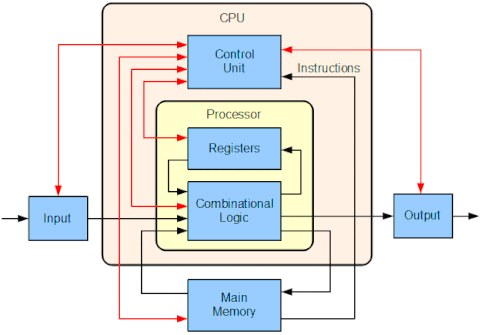
Block diagram of a basic figurer with uniprocessor CPU. Blackness lines point data flow, whereas red lines indicate control menstruum. Arrows point the management of flow.
In computer applied science, computer architecture is a set of rules and methods that describe the functionality, arrangement, and implementation of computer systems. The architecture of a system refers to its construction in terms of separately specified components of that arrangement and their interrelationships.[1]
Some definitions of architecture ascertain it every bit describing the capabilities and programming model of a estimator but not a particular implementation.[2] In other definitions computer architecture involves instruction set architecture design, microarchitecture pattern, logic design, and implementation.[3]
History [edit]
The starting time documented figurer compages was in the correspondence between Charles Babbage and Ada Lovelace, describing the analytical engine. When building the computer Z1 in 1936, Konrad Zuse described in two patent applications for his hereafter projects that machine instructions could be stored in the same storage used for information, i.e., the stored-program concept.[4] [5] Two other early and important examples are:
- John von Neumann'due south 1945 newspaper, Outset Draft of a Written report on the EDVAC, which described an system of logical elements;[vi] and
- Alan Turing's more than detailed Proposed Electronic Computer for the Automated Calculating Engine, too 1945 and which cited John von Neumann's paper.[seven]
The term "compages" in reckoner literature tin can be traced to the piece of work of Lyle R. Johnson and Frederick P. Brooks, Jr., members of the Auto Arrangement department in IBM's main research center in 1959. Johnson had the opportunity to write a proprietary inquiry advice about the Stretch, an IBM-developed supercomputer for Los Alamos National Laboratory (at the time known equally Los Alamos Scientific Laboratory). To depict the level of detail for discussing the luxuriously embellished estimator, he noted that his description of formats, instruction types, hardware parameters, and speed enhancements were at the level of "system compages", a term that seemed more useful than "machine organization".[8]
Afterwards, Brooks, a Stretch designer, opened Chapter 2 of a book called Planning a Estimator System: Projection Stretch by stating, "Figurer architecture, like other compages, is the fine art of determining the needs of the user of a structure and and so designing to come across those needs as finer as possible inside economic and technological constraints."[ix]
Brooks went on to assist develop the IBM System/360 (now chosen the IBM zSeries) line of computers, in which "architecture" became a noun defining "what the user needs to know".[10] Later on, computer users came to utilise the term in many less explicit ways.[xi]
The primeval computer architectures were designed on paper and and so directly congenital into the final hardware form.[12] Later, calculator compages prototypes were physically built in the grade of a transistor–transistor logic (TTL) computer—such every bit the prototypes of the 6800 and the PA-RISC—tested, and tweaked, before committing to the final hardware form. Equally of the 1990s, new figurer architectures are typically "congenital", tested, and tweaked—within some other figurer architecture in a estimator architecture simulator; or inside a FPGA as a soft microprocessor; or both—earlier committing to the final hardware form.[thirteen]
Subcategories [edit]
The field of study of computer architecture has 3 main subcategories:[14]
- Didactics set architecture (ISA): defines the auto lawmaking that a processor reads and acts upon likewise equally the word size, memory address modes, processor registers, and information type.
- Microarchitecture: also known as "computer organisation", this describes how a particular processor will implement the ISA.[xv] The size of a computer's CPU cache for case, is an issue that by and large has cipher to do with the ISA.
- Systems pattern: includes all of the other hardware components within a calculating system, such as data processing other than the CPU (e.k., direct memory access), virtualization, and multiprocessing.
At that place are other technologies in reckoner architecture. The following technologies are used in bigger companies like Intel, and were estimated in 2002[14] to count for 1% of all of computer architecture:
- Macroarchitecture: architectural layers more than abstract than microarchitecture
- Assembly pedagogy ready architecture: A smart assembler may convert an abstract assembly linguistic communication common to a group of machines into slightly different machine language for dissimilar implementations.
- Developer-visible macroarchitecture: higher-level language tools such every bit compilers may define a consistent interface or contract to programmers using them, abstracting differences between underlying ISA, UISA, and microarchitectures. For case, the C, C++, or Java standards define different developer-visible macroarchitectures.
- Microcode: microcode is software that translates instructions to run on a chip. It acts like a wrapper effectually the hardware, presenting a preferred version of the hardware's instruction set interface. This pedagogy translation facility gives fleck designers flexible options: E.g. i. A new improved version of the scrap tin use microcode to present the verbal same pedagogy set equally the old chip version, so all software targeting that instruction set will run on the new chip without needing changes. E.k. ii. Microcode can nowadays a variety of instruction sets for the same underlying chip, allowing it to run a wider diversity of software.
- UISA: User Didactics Set up Compages, refers to one of three subsets of the RISC CPU instructions provided by PowerPC RISC Processors. The UISA subset, are those RISC instructions of involvement to application developers. The other two subsets are VEA (Virtual Environment Architecture) instructions used by virtualisation arrangement developers, and OEA (Operating Environment Compages) used past Performance System developers.[16]
- Pivot architecture: The hardware functions that a microprocessor should provide to a hardware platform, e.k., the x86 pins A20M, FERR/IGNNE or FLUSH. Also, messages that the processor should emit so that external caches can be invalidated (emptied). Pivot architecture functions are more flexible than ISA functions because external hardware can adapt to new encodings, or modify from a pin to a message. The term "architecture" fits, considering the functions must be provided for uniform systems, even if the detailed method changes.
Roles [edit]
Definition [edit]
Computer architecture is concerned with balancing the performance, efficiency, cost, and reliability of a computer system. The case of instruction set up architecture tin can exist used to illustrate the balance of these competing factors. More than complex instruction sets enable programmers to write more space efficient programs, since a unmarried instruction tin encode some college-level abstraction (such equally the x86 Loop instruction).[17] However, longer and more than complex instructions take longer for the processor to decode and tin be more costly to implement effectively. The increased complexity from a large instruction set besides creates more room for unreliability when instructions interact in unexpected ways.
The implementation involves integrated circuit pattern, packaging, power, and cooling. Optimization of the design requires familiarity with compilers, operating systems to logic pattern, and packaging.[18]
Instruction set up architecture [edit]
An didactics set architecture (ISA) is the interface betwixt the calculator's software and hardware and too can be viewed equally the developer's view of the machine. Computers exercise not sympathize high-level programming languages such as Java, C++, or most programming languages used. A processor simply understands instructions encoded in some numerical fashion, usually as binary numbers. Software tools, such as compilers, translate those loftier level languages into instructions that the processor tin empathise.
Too instructions, the ISA defines items in the computer that are available to a programme—eastward.g., data types, registers, addressing modes, and memory. Instructions locate these available items with register indexes (or names) and memory addressing modes.
The ISA of a estimator is ordinarily described in a minor teaching transmission, which describes how the instructions are encoded. Also, information technology may ascertain short (vaguely) mnemonic names for the instructions. The names can exist recognized by a software development tool called an assembler. An assembler is a figurer plan that translates a man-readable form of the ISA into a computer-readable form. Disassemblers are likewise widely bachelor, usually in debuggers and software programs to isolate and correct malfunctions in binary figurer programs.
ISAs vary in quality and completeness. A good ISA compromises betwixt programmer convenience (how easy the lawmaking is to sympathize), size of the code (how much lawmaking is required to do a specific action), cost of the computer to interpret the instructions (more than complexity ways more hardware needed to decode and execute the instructions), and speed of the computer (with more circuitous decoding hardware comes longer decode time). Memory organization defines how instructions interact with the memory, and how memory interacts with itself.
During design emulation, emulators can run programs written in a proposed instruction prepare. Mod emulators tin can mensurate size, cost, and speed to determine whether a particular ISA is meeting its goals.
Reckoner organization [edit]
Computer organization helps optimize performance-based products. For example, software engineers need to know the processing power of processors. They may need to optimize software in guild to gain the most performance for the lowest cost. This can require quite a detailed analysis of the estimator'southward organization. For instance, in an SD bill of fare, the designers might demand to adjust the card so that the most information tin can exist candy in the fastest possible way.
Reckoner organization likewise helps plan the selection of a processor for a particular project. Multimedia projects may need very rapid data access, while virtual machines may need fast interrupts. Sometimes sure tasks need additional components also. For example, a reckoner capable of running a virtual machine needs virtual memory hardware so that the memory of different virtual computers tin be kept separated. Computer system and features besides impact power consumption and processor cost.
Implementation [edit]
One time an instruction set and micro-architecture have been designed, a practical machine must be developed. This design procedure is called the implementation. Implementation is unremarkably non considered architectural design, but rather hardware design engineering. Implementation can exist further broken downwards into several steps:
- Logic implementation designs the circuits required at a logic-gate level.
- Circuit implementation does transistor-level designs of basic elements (e.g., gates, multiplexers, latches) also as of some larger blocks (ALUs, caches etc.) that may exist implemented at the logic-gate level, or fifty-fifty at the concrete level if the design calls for it.
- Concrete implementation draws concrete circuits. The different excursion components are placed in a chip floorplan or on a board and the wires connecting them are created.
- Design validation tests the figurer as a whole to see if it works in all situations and all timings. One time the design validation procedure starts, the blueprint at the logic level are tested using logic emulators. All the same, this is usually too slow to run a realistic test. Then, after making corrections based on the showtime test, prototypes are synthetic using Field-Programmable Gate-Arrays (FPGAs). Nigh hobby projects end at this stage. The final step is to test paradigm integrated circuits, which may require several redesigns.
For CPUs, the entire implementation process is organized differently and is oftentimes referred to as CPU blueprint.
Blueprint goals [edit]
The exact form of a reckoner system depends on the constraints and goals. Computer architectures usually merchandise off standards, ability versus performance, cost, memory capacity, latency (latency is the corporeality of time that it takes for information from one node to travel to the source) and throughput. Sometimes other considerations, such as features, size, weight, reliability, and expandability are also factors.
The nearly mutual scheme does an in-depth power analysis and figures out how to keep power consumption low while maintaining adequate performance.
Operation [edit]
Modern computer performance is often described in instructions per cycle (IPC), which measures the efficiency of the architecture at any clock frequency; a faster IPC rate means the estimator is faster. Older computers had IPC counts as low equally 0.1 while modern processors easily achieve near 1. Superscalar processors may reach 3 to five IPC past executing several instructions per clock cycle.[ citation needed ]
Counting machine-language instructions would exist misleading because they can do varying amounts of work in dissimilar ISAs. The "teaching" in the standard measurements is not a count of the ISA'south auto-language instructions, but a unit, ordinarily based on the speed of the VAX computer architecture.
Many people used to mensurate a calculator'south speed by the clock rate (usually in MHz or GHz). This refers to the cycles per second of the primary clock of the CPU. However, this metric is somewhat misleading, as a machine with a higher clock rate may not necessarily accept greater performance. As a consequence, manufacturers have moved away from clock speed as a measure of performance.
Other factors influence speed, such as the mix of functional units, motorbus speeds, available retentiveness, and the type and gild of instructions in the programs.
There are two main types of speed: latency and throughput. Latency is the time between the kickoff of a process and its completion. Throughput is the amount of work done per unit time. Interrupt latency is the guaranteed maximum response time of the system to an electronic event (like when the deejay drive finishes moving some data).
Functioning is afflicted by a very broad range of design choices — for example, pipelining a processor usually makes latency worse, but makes throughput amend. Computers that command machinery usually need low interrupt latencies. These computers operate in a existent-time environs and fail if an functioning is not completed in a specified amount of fourth dimension. For example, computer-controlled anti-lock brakes must brainstorm braking within a predictable and limited fourth dimension period after the brake pedal is sensed or else failure of the brake will occur.
Benchmarking takes all these factors into account by measuring the time a computer takes to run through a series of test programs. Although benchmarking shows strengths, it shouldn't be how you lot choose a computer. Often the measured machines split on unlike measures. For example, one organisation might handle scientific applications quickly, while another might render video games more smoothly. Furthermore, designers may target and add special features to their products, through hardware or software, that permit a specific criterion to execute quickly just don't offering similar advantages to general tasks.
Power efficiency [edit]
Ability efficiency is another important measurement in modern computers. A higher power efficiency tin can often be traded for lower speed or higher cost. The typical measurement when referring to ability consumption in computer architecture is MIPS/Due west (millions of instructions per 2d per watt).
Modern circuits have less power required per transistor as the number of transistors per bit grows.[19] This is because each transistor that is put in a new chip requires its own power supply and requires new pathways to exist built to power it. Even so the number of transistors per chip is starting to increase at a slower rate. Therefore, power efficiency is starting to become as important, if not more important than fitting more and more than transistors into a single fleck. Recent processor designs accept shown this emphasis as they put more focus on power efficiency rather than cramming as many transistors into a single chip as possible.[20] In the world of embedded computers, power efficiency has long been an important goal next to throughput and latency.
Shifts in market demand [edit]
Increases in clock frequency take grown more slowly over the past few years, compared to power reduction improvements. This has been driven by the stop of Moore'due south Law and need for longer bombardment life and reductions in size for mobile technology. This change in focus from higher clock rates to ability consumption and miniaturization can be shown by the significant reductions in ability consumption, as much as 50%, that were reported by Intel in their release of the Haswell microarchitecture; where they dropped their ability consumption benchmark from xxx to 40 watts downward to 10-xx watts.[21] Comparing this to the processing speed increment of three GHz to 4 GHz (2002 to 2006)[22] information technology tin exist seen that the focus in enquiry and development are shifting away from clock frequency and moving towards consuming less ability and taking up less infinite.
Encounter also [edit]
- Comparison of CPU architectures
- Computer hardware
- CPU blueprint
- Floating point
- Harvard architecture (Modified)
- Dataflow architecture
- Transport triggered architecture
- Reconfigurable computing
- Influence of the IBM PC on the personal estimator market place
- Orthogonal instruction gear up
- Software architecture
- von Neumann architecture
- Flynn's taxonomy
References [edit]
- ^ Dragoni, Nicole (n.d.). "Introduction to peer to peer computing" (PDF). DTU Compute – Department of Applied Mathematics and Information science. Lyngby, Denmark.
- ^ Clements, Alan. Principles of Reckoner Hardware (4th ed.). p. 1.
Compages describes the internal organization of a computer in an abstract fashion; that is, it defines the capabilities of the estimator and its programming model. You can have ii computers that take been constructed in different ways with dissimilar technologies only with the same architecture.
- ^ Hennessy, John; Patterson, David. Figurer Compages: A Quantitative Approach (Fifth ed.). p. 11.
This task has many aspects, including instruction set design, functional organization, logic design, and implementation.
- ^ Williams, F. C.; Kilburn, T. (25 September 1948), "Electronic Digital Computers", Nature, 162 (4117): 487, Bibcode:1948Natur.162..487W, doi:10.1038/162487a0, S2CID 4110351, archived from the original on 6 April 2009, retrieved 2009-04-10
- ^ Susanne Faber, "Konrad Zuses Bemuehungen um dice Patentanmeldung der Z3", 2000
- ^ Neumann, John (1945). First Draft of a Report on the EDVAC. p. 9.
- ^ Reproduced in B. J. Copeland (Ed.), "Alan Turing's Automatic Calculating Engine", Oxford University Press, 2005, pp. 369-454.
- ^ Johnson, Lyle (1960). "A Description of Stretch" (PDF). p. 1. Retrieved vii October 2017.
- ^ Buchholz, Werner (1962). Planning a Computer System. p. 5.
- ^ "System 360, From Computers to Estimator Systems". IBM100. 7 March 2012. Retrieved eleven May 2017.
- ^ Hellige, Hans Dieter (2004). "Die Genese von Wissenschaftskonzeptionen der Computerarchitektur: Vom "organisation of organs" zum Schichtmodell des Designraums". Geschichten der Informatik: Visionen, Paradigmen, Leitmotive. pp. 411–472.
- ^ ACE underwent seven paper designs in one year, before a paradigm was initiated in 1948. [B. J. Copeland (Ed.), "Alan Turing's Automatic Computing Engine", OUP, 2005, p. 57]
- ^ Schmalz, G.S. "System of Computer Systems". UF CISE . Retrieved 11 May 2017.
- ^ a b John L. Hennessy and David A. Patterson. Estimator Architecture: A Quantitative Approach (Tertiary ed.). Morgan Kaufmann Publishers.
- ^ Laplante, Phillip A. (2001). Lexicon of Calculator Science, Engineering science, and Technology. CRC Printing. pp. 94–95. ISBN0-8493-2691-5.
- ^ Frey, Brad (2005-02-24). "PowerPC Architecture Volume, Version 2.02". IBM Corporation.
- ^ Null, Linda (2019). The Essentials of Computer Organisation and Architecture (5th ed.). Burlington, MA: Jones & Bartlett Learning. p. 280. ISBN9781284123036.
- ^ Martin, Milo. "What is computer architecture?" (PDF). UPENN . Retrieved 11 May 2017.
- ^ "Integrated circuits and fabrication" (PDF) . Retrieved viii May 2017.
- ^ "Exynos 9 Series (8895)". Samsung . Retrieved 8 May 2017.
- ^ "Measuring Processor Ability TDP vs ACP" (PDF). Intel. April 2011. Retrieved five May 2017.
- ^ "History of Processor Performance" (PDF). cs.columbia.edu. 24 Apr 2012. Retrieved 5 May 2017.
Sources [edit]
- John Fifty. Hennessy and David Patterson (2006). Reckoner Architecture: A Quantitative Arroyo (Fourth ed.). Morgan Kaufmann. ISBN978-0-12-370490-0.
- Barton, Robert S., "Functional Design of Computers", Communications of the ACM four(nine): 405 (1961).
- Barton, Robert S., "A New Arroyo to the Functional Design of a Digital Computer", Proceedings of the Western Joint Computer Conference, May 1961, pp. 393–396. Near the design of the Burroughs B5000 computer.
- Bell, C. Gordon; and Newell, Allen (1971). "Computer Structures: Readings and Examples", McGraw-Hill.
- Blaauw, G.A., and Brooks, F.P., Jr., "The Structure of System/360, Part I-Outline of the Logical Structure", IBM Systems Periodical, vol. iii, no. 2, pp. 119–135, 1964.
- Tanenbaum, Andrew South. (1979). Structured Figurer Organization. Englewood Cliffs, New Jersey: Prentice-Hall. ISBN0-xiii-148521-0.
External links [edit]
- ISCA: Proceedings of the International Symposium on Estimator Architecture
- Micro: IEEE/ACM International Symposium on Microarchitecture
- HPCA: International Symposium on High Functioning Reckoner Architecture
- ASPLOS: International Conference on Architectural Support for Programming Languages and Operating Systems
- ACM Transactions on Compages and Code Optimization
- IEEE Transactions on Computers
- The von Neumann Architecture of Computer Systems
0 Response to "Additional Information About Form or Art or Architecture About the Computers"
Post a Comment